RTS
RTS
Introduction
Introduction
The purpose of this project is to help educate people on Rochester's Regional Transit System (RTS). I partnered with Campus ROC, an initiative by the Greater Rochester Chamber of Commerce and OneROC to make Rochester more accessible to students and show them that the city has much more to offer outside of their campus bubbles.
The purpose of this project is to help educate people on Rochester's Regional Transit System (RTS). I partnered with Campus ROC, an initiative by the Greater Rochester Chamber of Commerce and OneROC to make Rochester more accessible to students and show them that the city has much more to offer outside of their campus bubbles.
Stakeholder Meetings
Stakeholder Meetings
To identify my stakeholders and their needs, I first met with Andrea Tuttle and Naylea Santos from Campus ROC. Through my meetings with Campus ROC, I learned more about their mission which is to keep students from leaving the Rochester area by showing them what Rochester really has to offer. They do this by running events and other outreach channels including their current partnership with the folks at RTS. Through their own research, they found that people simply didn’t have the means to explore Rochester unless they had a car. By educating the student population of the Rochester area, RTS will be more accessible, circumventing the lack of knowledge problem.
I also met with Chris Doran who is in RTS’ Business Development Department to determine their expectations for this collaboration. Through this meeting, I was able to gather more information on how RTS’ U Pass and On Demand system works and who has access to these services. I was also informed on how the COVID-19 pandemic impacted driving patterns, weakening RTS’ relationship with local Universities, explaining the lack of accessibility on most campuses. I also gathered that not much data has been collected by RTS themselves, so any data that I could collect would be incredibly valuable.
To identify my stakeholders and their needs, I first met with Andrea Tuttle and Naylea Santos from Campus ROC. Through my meetings with Campus ROC, I learned more about their mission which is to keep students from leaving the Rochester area by showing them what Rochester really has to offer. They do this by running events and other outreach channels including their current partnership with the folks at RTS. Through their own research, they found that people simply didn’t have the means to explore Rochester unless they had a car. By educating the student population of the Rochester area, RTS will be more accessible, circumventing the lack of knowledge problem.
I also met with Chris Doran who is in RTS’ Business Development Department to determine their expectations for this collaboration. Through this meeting, I was able to gather more information on how RTS’ U Pass and On Demand system works and who has access to these services. I was also informed on how the COVID-19 pandemic impacted driving patterns, weakening RTS’ relationship with local Universities, explaining the lack of accessibility on most campuses. I also gathered that not much data has been collected by RTS themselves, so any data that I could collect would be incredibly valuable.
RTS Website Evaluation
RTS Website Evaluation
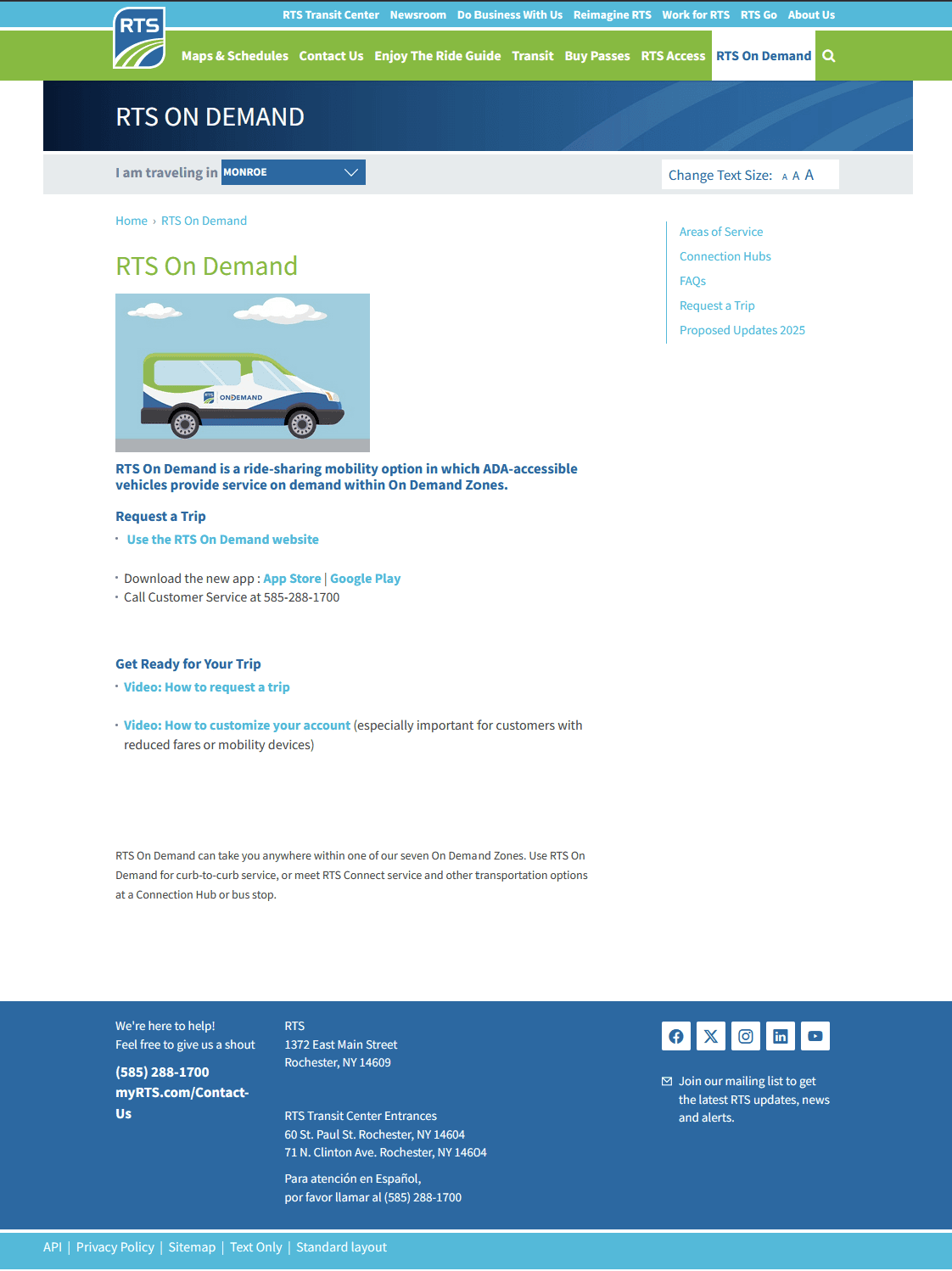
In order to begin researching, I also needed to have an understanding of the current informational tool for RTS’ various systems. Looking through their website, I found that it was very difficult to figure out information on how to use each service. In particular, RTS On Demand’s primary informational page requires you to go to a different website in order to use the service, is confusingly laid out, and doesn’t tell you what areas the service is available in.
Here is the current RTS On Demand webpage:
In order to begin researching, I also needed to have an understanding of the current informational tool for RTS’ various systems. Looking through their website, I found that it was very difficult to figure out information on how to use each service. In particular, RTS On Demand’s primary informational page requires you to go to a different website in order to use the service, is confusingly laid out, and doesn’t tell you what areas the service is available in.
Here is the current RTS On Demand webpage:
Problem
Problem
Campus ROC wanted to focus on public transportation for our collaboration. Originally, the problem appeared to be that students didn’t use public transportation because they were never informed on it. Based on the research I had done so far, I hypothesized that students who didn’t use RTS hadn’t heard about the system and it’s services before. I also hypothesized that the information on how to use RTS’ various systems was convoluted and difficult to find for the average user.
How might we make RTS more accessible for students in order to expand their perception on what Rochester has to offer?
Campus ROC wanted to focus on public transportation for our collaboration. Originally, the problem appeared to be that students didn’t use public transportation because they were never informed on it. Based on the research I had done so far, I hypothesized that students who didn’t use RTS hadn’t heard about the system and it’s services before. I also hypothesized that the information on how to use RTS’ various systems was convoluted and difficult to find for the average user.
How might we make RTS more accessible for students in order to expand their perception on what Rochester has to offer?
Survey
Survey
We wanted to get as many data points as possible in order to test these hypotheses. Andrea Tuttle distributed the survey out amongst all of her contacts in student governments to spread the survey to as many people in as many different Universities/Colleges as possible.
We wanted to get as many data points as possible in order to test these hypotheses. Andrea Tuttle distributed the survey out amongst all of her contacts in student governments to spread the survey to as many people in as many different Universities/Colleges as possible.
Design
Design
First, we needed to collect some basic demographic data: age, gender identity, which school they attend, and what year are they. Then we needed some specifics about how far from campus they live and how they typically get around Rochester. Next, I split the surveyors into people who use and don’t use RTS services. This way, I could ask more targeted questions about the different experiences. For example, I wanted to know what people use RTS for and which services they use. I also wanted to know what reasons people had for not using RTS. As an incentive, we included a gift card prize for anyone who submitted a response.
First, we needed to collect some basic demographic data: age, gender identity, which school they attend, and what year are they. Then we needed some specifics about how far from campus they live and how they typically get around Rochester. Next, I split the surveyors into people who use and don’t use RTS services. This way, I could ask more targeted questions about the different experiences. For example, I wanted to know what people use RTS for and which services they use. I also wanted to know what reasons people had for not using RTS. As an incentive, we included a gift card prize for anyone who submitted a response.
Results
Results
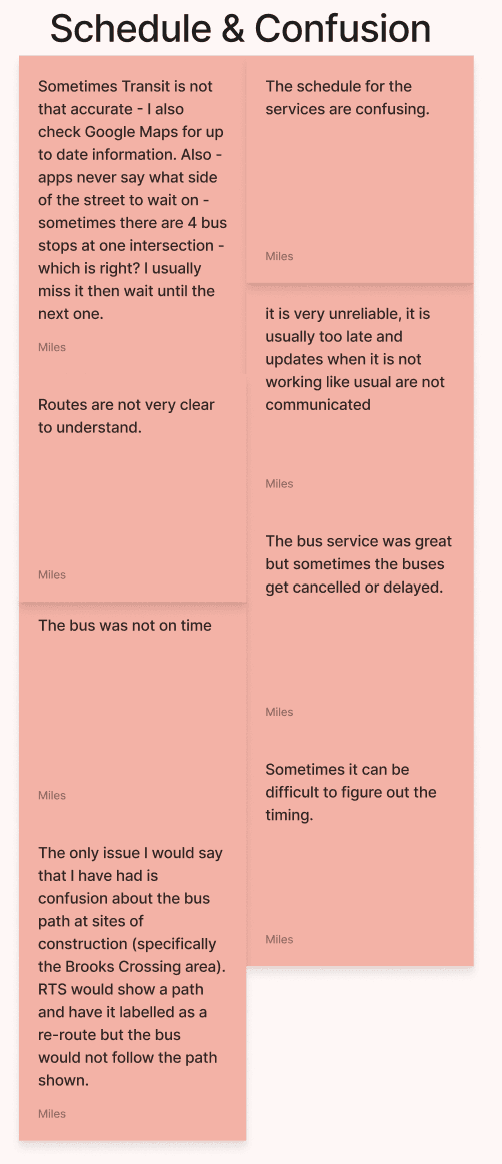
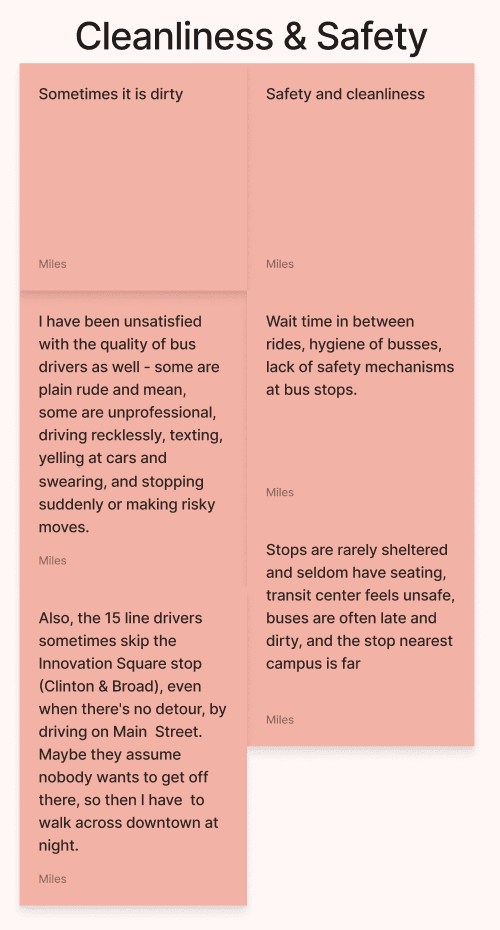
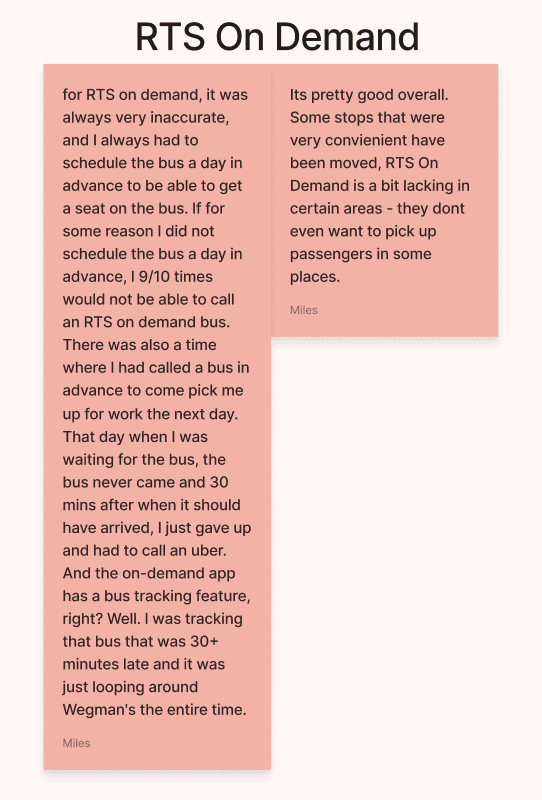
As of the end of this semester, I have received 85 responses from a wide variety of demographics. By affinity mapping my qualitative data, I was able to determine some more specific pain points that people had with RTS services. While some of the information isn’t applicable to myself, it will likely be valuable information when I pass off my work to RTS. The main point that is addressable by my project, is that people have difficulties with the accessibility and confusion in regards to the schedule.
Here are the main insights we gained from this survey:
People get around Rochester in a variety of ways
(57.6%) School Provided Transportation
(54.1%) Walk
(45.9%) RTS
(44.7%) Uber/Lyft
(31.8%) Personal Car
Most of the respondents use RTS for errands and to explore Rochester
70% of respondents heard about RTS through word of mouth and 15% of them learned through a search engine
The most used RTS services amongst respondents were:
Predetermined bus routes
Transit App
RTS On Demand (around 1/3 of respondents!)
To be even more specific, 56% of respondents have reportedly heard about RTS On Demand
As of the end of this semester, I have received 85 responses from a wide variety of demographics. By affinity mapping my qualitative data, I was able to determine some more specific pain points that people had with RTS services. While some of the information isn’t applicable to myself, it will likely be valuable information when I pass off my work to RTS. The main point that is addressable by my project, is that people have difficulties with the accessibility and confusion in regards to the schedule.
Here are the main insights we gained from this survey:
People get around Rochester in a variety of ways
(57.6%) School Provided Transportation
(54.1%) Walk
(45.9%) RTS
(44.7%) Uber/Lyft
(31.8%) Personal Car
Most of the respondents use RTS for errands and to explore Rochester
70% of respondents heard about RTS through word of mouth and 15% of them learned through a search engine
The most used RTS services amongst respondents were:
Predetermined bus routes
Transit App
RTS On Demand (around 1/3 of respondents!)
To be even more specific, 56% of respondents have reportedly heard about RTS On Demand
Prototyping
Prototyping
I went into the prototyping phase with the knowledge I had gained from my user research as well as specific requests from my community partner. I wanted to create a framework that could be easily copied across multiple schools, giving each school an example of how they can use RTS.
Here is an overview of the prototype evolution:
I went into the prototyping phase with the knowledge I had gained from my user research as well as specific requests from my community partner. I wanted to create a framework that could be easily copied across multiple schools, giving each school an example of how they can use RTS.
Here is an overview of the prototype evolution:
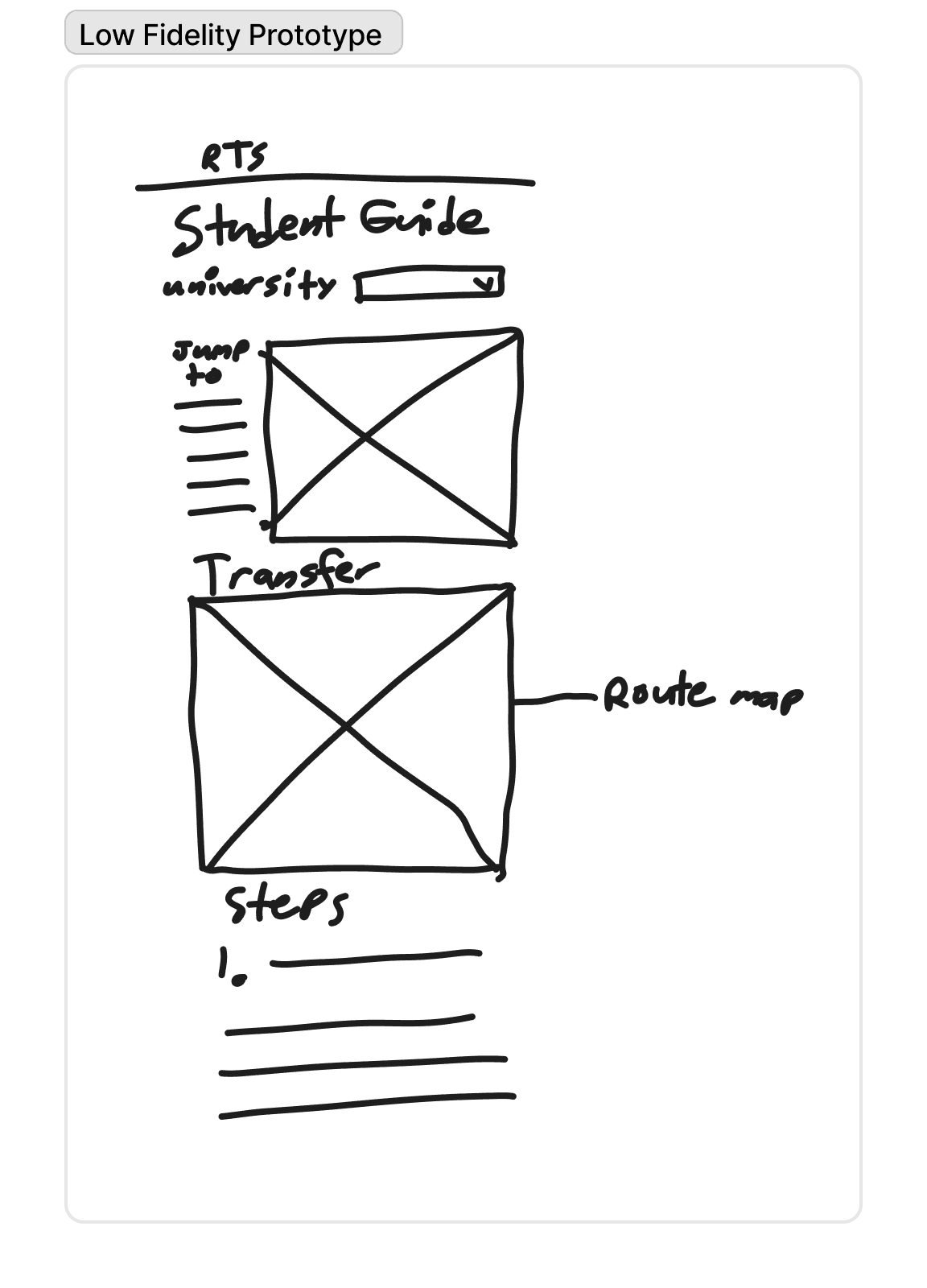
Low-Fidelity Prototype
Low-Fidelity
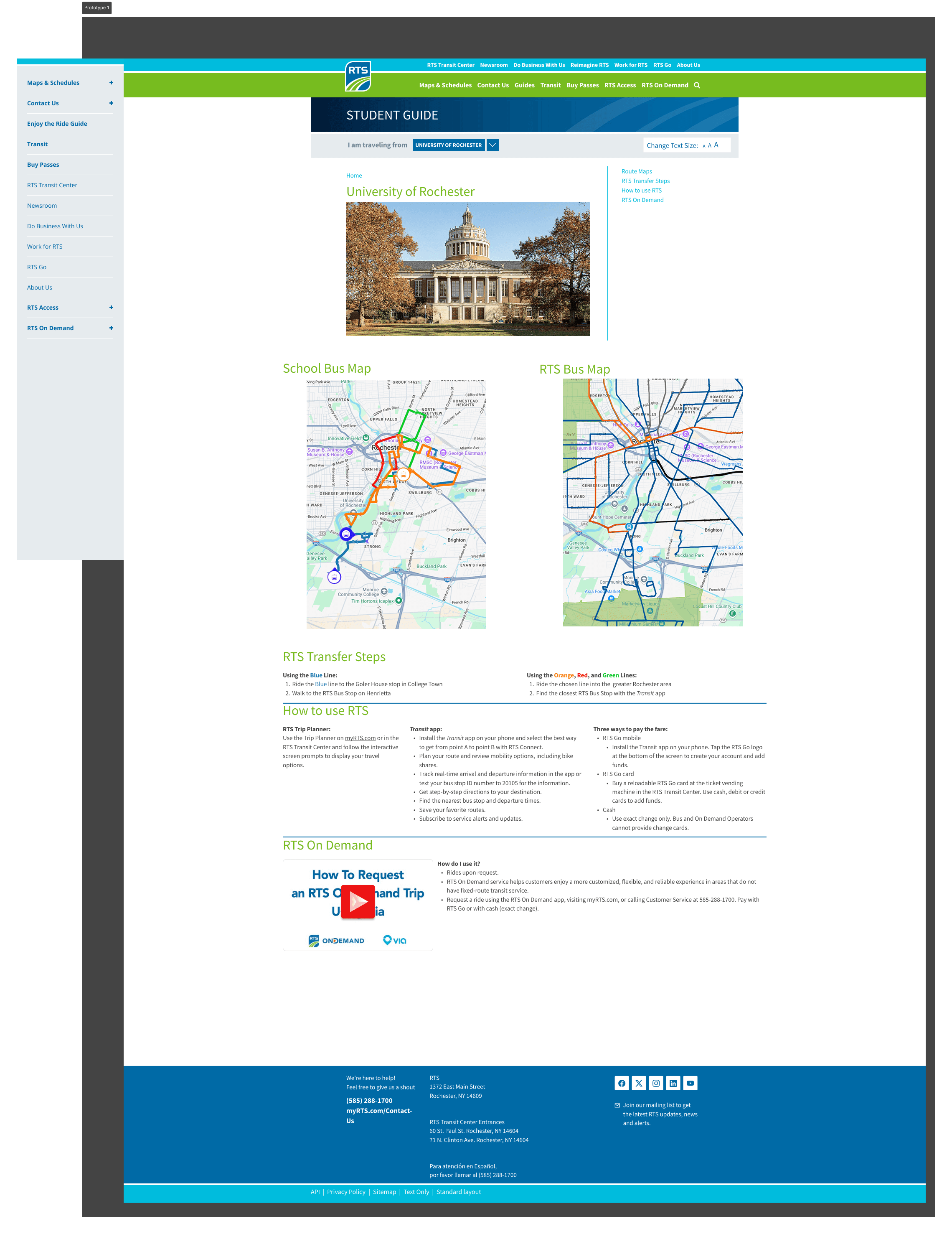
Mid-Fidelity Prototype
Mid-Fidelity
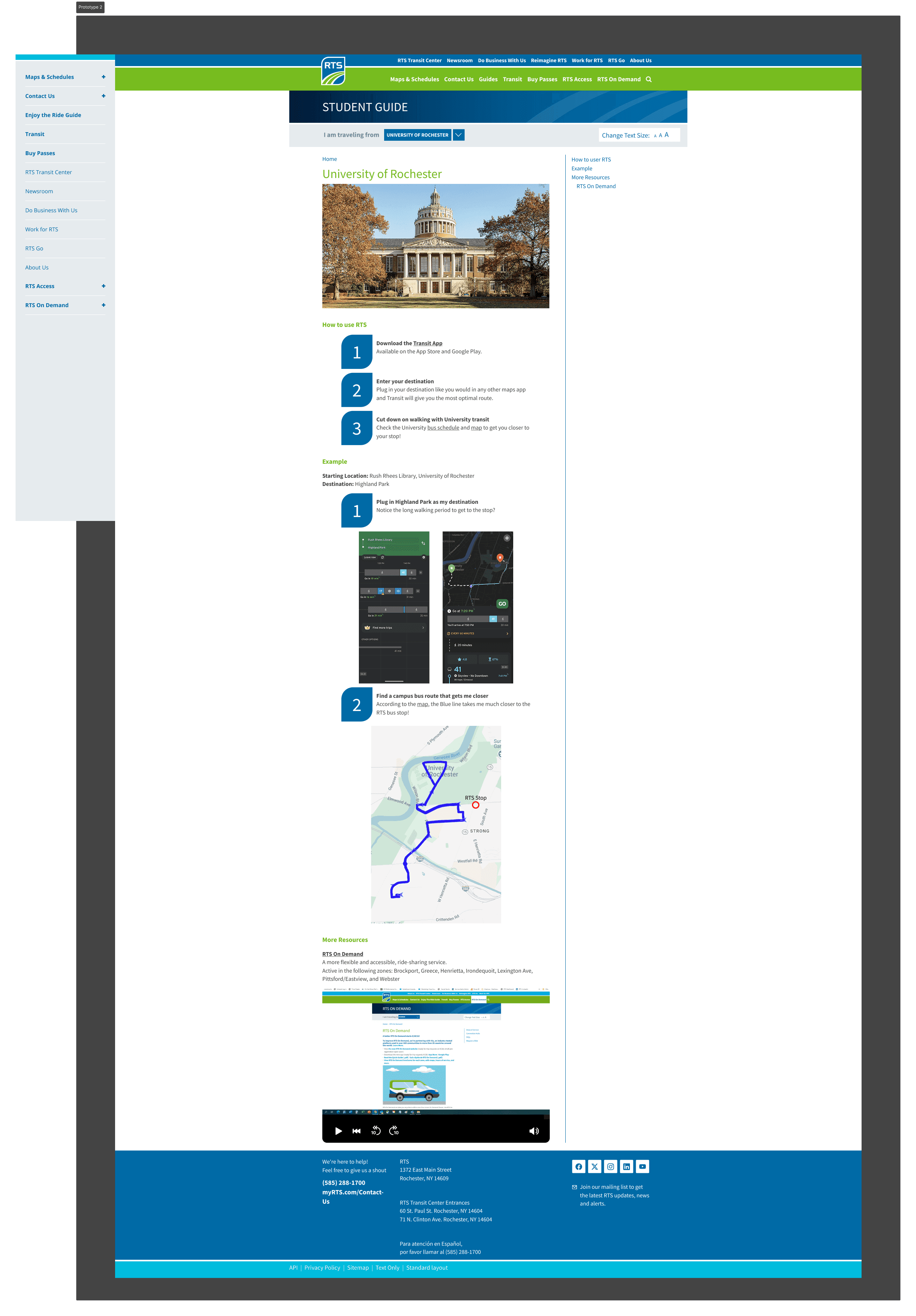
High-Fidelity Prototype
High-Fidelity
Process & Considerations
Process & Considerations
Moving into my mid-fidelity prototype, I needed to consider the current layout, hierarchy, and colors of the current website. I made sure to use colors that fit within RTS’ current visual identity and laid out the menu systems the way it currently is on the site.
Moving into my mid-fidelity prototype, I needed to consider the current layout, hierarchy, and colors of the current website. I made sure to use colors that fit within RTS’ current visual identity and laid out the menu systems the way it currently is on the site.
Testing
Testing
After creating the mid-fidelity prototype, I ran some user testing to learn more about any usability pitfalls there might be. I learned a lot from this process which resulted in a number of different changes including type color changes, copy changes, and just general simplification of the site.
After creating the mid-fidelity prototype, I ran some user testing to learn more about any usability pitfalls there might be. I learned a lot from this process which resulted in a number of different changes including type color changes, copy changes, and just general simplification of the site.
High-Fidelity Prototype
High-Fidelity Prototype
Here is the final prototype! I went with a simpler 3 step method for using RTS and then I included an example tailored to the selected school fit with familiar screenshots of what the user will be seeing.
Here is the final prototype! I went with a simpler 3 step method for using RTS and then I included an example tailored to the selected school fit with familiar screenshots of what the user will be seeing.
Proposed Changes
Proposed Changes
Here are some changes that I am proposing RTS makes to their website based on my research.
Hierarchy changes: Changing the top menu bar to include both the “Student Guide” and the existing “Enjoy The Ride Guide” under a more clear “Guides” tab
In the top menu bar, change “Enjoy The Ride Guide” to “Guides”
Add new page called “Student Guide”
Give the new “Guides” tab dropdown options of “Enjoy The Ride Guide” and “Student Guide”
Color change
One of the primary colors present on the site is Robin’s Egg Blue which has a low contrast ratio (2.27 : 1) resulting in low readability. I recommend changing text with this color to a darker one such as #0069A6 which boasts a higher contrast level of 5.88 : 1
To fit this new theming, I also adjusted the topmost menu bar to the latter color as well as anything else on the page that was Robin’s Egg Blue
Here are some changes that I am proposing RTS makes to their website based on my research.
Hierarchy changes: Changing the top menu bar to include both the “Student Guide” and the existing “Enjoy The Ride Guide” under a more clear “Guides” tab
In the top menu bar, change “Enjoy The Ride Guide” to “Guides”
Add new page called “Student Guide”
Give the new “Guides” tab dropdown options of “Enjoy The Ride Guide” and “Student Guide”
Color change
One of the primary colors present on the site is Robin’s Egg Blue which has a low contrast ratio (2.27 : 1) resulting in low readability. I recommend changing text with this color to a darker one such as #0069A6 which boasts a higher contrast level of 5.88 : 1
To fit this new theming, I also adjusted the topmost menu bar to the latter color as well as anything else on the page that was Robin’s Egg Blue
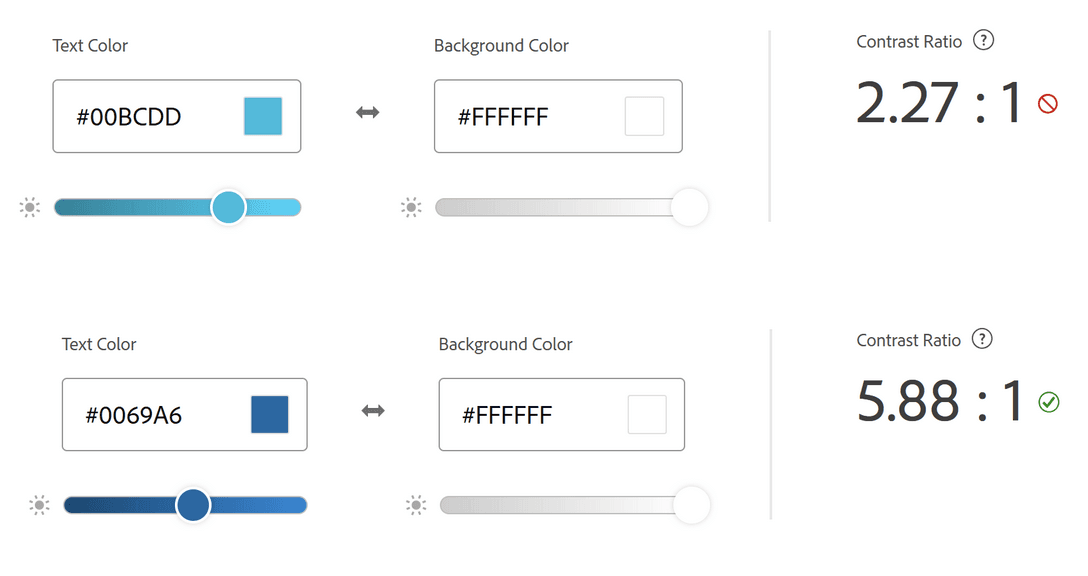
Robin's Egg Blue Contrast Test
Robin's Egg Blue Contrast Test